
For most of the history of cataract surgery, choosing a lens meant deciding from a list of features you had never actually experienced. At ilumin in Omaha, patients can now put on a headset and see how each lens type is designed to perform in the situations that matter most to them: reading, driving at night, working at a computer. Your surgeon’s exam and measurements still determine which lens is right for you, but now you can see the possibilities before that conversation even starts.
Why Lens Decisions Are So Hard To Make On Paper
Cataract surgery itself isn’t really the hard part. Most patients understand, broadly, what the surgery involves. It’s the lens that gives people pause.
You’re handed a list of categories: monofocal, toric, presbyopia-correcting, Light Adjustable. Each comes with phrases like “extended depth of focus” or “reduced dependence on glasses,” and every one of those phrases describes an experience you’ve never had. For premium lens options, you’re also weighing a cost, which means committing to something you can’t quite picture yet.
That’s a reasonable thing to feel stuck on. This isn’t a decision about a feature on a spec sheet. It’s a decision about how you’ll see your kitchen counter, your car’s dashboard, or your grandchild’s face for years to come. Feeling unsure at this stage doesn’t mean you’re overthinking it. It means the choice matters.
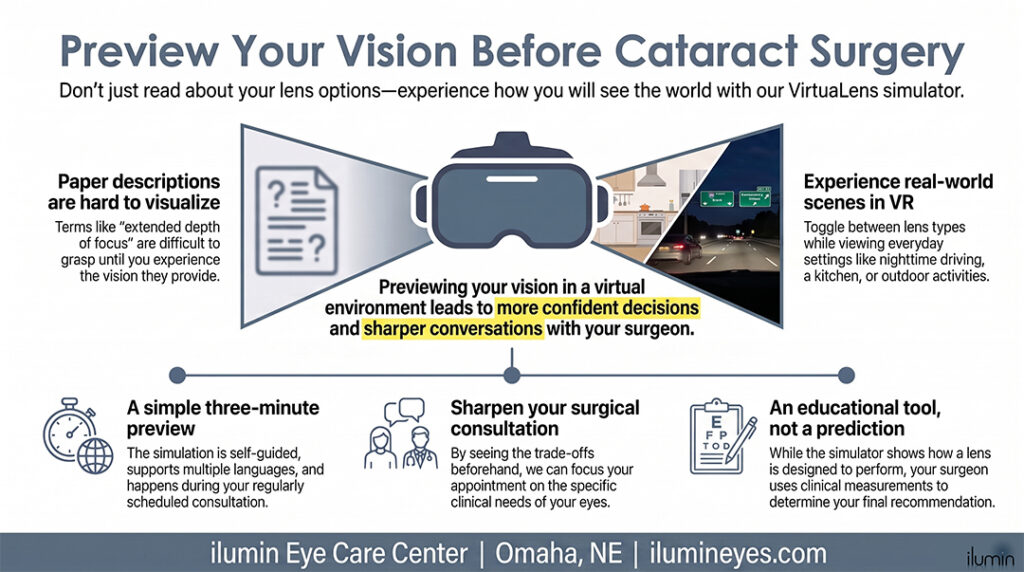
What A Virtual Reality Lens Simulator Shows You
ilumin uses VirtuaLens, a virtual reality lens simulator built specifically for cataract education, to help make that choice more concrete. It works in three simple steps.
First, you choose a scene: an everyday setting like nighttime driving, a kitchen, or an outdoor activity. Then you toggle between lens types within that same scene. Finally, you compare them side by side, so the difference is something you see rather than something you’re told.
The simulation can also account for what you’re already experiencing, including astigmatism, nearsightedness, farsightedness, presbyopia, and the glare, halos, and starbursts that make night driving harder for many cataract patients. Seeing those effects modeled tends to raise questions patients wouldn’t have thought to ask from a brochure alone.
In practice, the experience takes about three to five minutes. You keep your glasses on throughout, and there’s no movement within the simulation itself, so patients who are sensitive to motion generally don’t have trouble with it. A self-guided mode is available for patients who prefer to explore at their own pace, and the tool supports multiple languages. Best of all, it happens during the consultation you already have scheduled. There’s nothing extra to book and nothing extra to plan for.
What The Simulation Cannot Tell You
The VirtuaLens shows you how a lens type is designed to perform. It doesn’t predict what you, specifically, will see after your surgery. Your cornea’s shape, the length of your eye, how you heal, and any other conditions you’re managing all shape your actual result, and none of that can be modeled in a headset. It’s an educational tool, not a prediction of your individual outcome.
Previewing a presbyopia-correcting lens also isn’t a promise that you’ll never reach for reading glasses again. What the simulation does give you is a reference point. Instead of walking into your consultation guessing at what terms like “reduced dependence on glasses” actually mean, you walk in having seen it, which tends to make the conversation with your surgeon more useful for both of you.
ILUMINate Your Vision
Schedule a consultation with Omaha’s premier medical and surgical eye care team and discover the custom refractive procedure built for your eyes.
How Your Lens Actually Gets Chosen
The headset doesn’t choose your lens. Your surgeon does, based on measurements the simulation can’t see.
Before any recommendation is made, the ophthalmologists at ilumin evaluate the shape of your cornea, the length of your eye, the health of your retina, and any conditions that could affect your outcome. That clinical picture, combined with what you’ve told them about how you actually use your vision day to day, is what shapes the final recommendation.
“Patients who’ve tried the simulation tend to ask sharper questions,” says Dr. Peter Simone, MD, PhD, board-certified ophthalmologist and Fellow of the American Academy of Ophthalmology at ilumin Eye Care Center. “They’ve already seen the trade-offs, so we can spend our time on what matters for their eyes specifically, rather than starting from scratch.”
The simulation supports that conversation. Dr. Brandon Menke, MD, board-certified ophthalmologist at ilumin Eye Care Center, and Dr. Simone both walk patients through their measurements and options in detail before any lens is recommended. For the full clinical picture, including how to compare monofocal, toric, multifocal, and Light Adjustable lenses, our intraocular lens page covers each option in depth.
It’s Not Just For Cataract Patients
Not everyone weighing these lens options has cataracts. Refractive Lens Exchange uses the same lens categories to address the near-vision changes that show up in your forties and fifties, before a cataract has developed.
If you’re in that range and not sure which conversation applies to you, that’s a normal place to be, and it’s one the simulation is genuinely useful for either way, since the lens choices in front of you don’t change based on which path brought you there.
What To Expect At Your Consultation
If you’re getting ready for cataract surgery in Omaha, the lens simulation is part of your consultation at ilumin’s Lakeside office. There’s no separate appointment to book and no additional cost.
Plan on spending a few minutes with the headset partway through your visit, after your measurements are taken and before you and your surgeon talk through your options together. Patients travel to ilumin from across the Omaha metro area, including Council Bluffs, Bellevue, and Papillion, for this kind of visit. ilumin is the first practice in Nebraska to offer VirtuaLens.
Not sure whether it’s time to have that conversation yet? Our free vision self-test is a good place to start.
Frequently Asked Questions
Can I see what my vision will look like after cataract surgery?
Not your exact result, no. What you can see is how each lens type is designed to perform in everyday scenes like night driving, reading, or working on a computer. Your individual outcome depends on your own measurements, anatomy, and healing, all of which your surgeon evaluates separately during your exam.
How long does the lens simulation take?
About three to five minutes. It happens as part of the cataract consultation you already have scheduled at ilumin’s Lakeside office, so there’s nothing extra to book and no separate appointment needed.
Is there a cost to try it?
No. The lens simulation is included in your regular cataract consultation at ilumin’s Lakeside office in Omaha. There’s no additional fee and no separate visit required to try it.
Will it make me dizzy or motion sick?
Most patients don’t have any trouble with it. There’s no movement within the simulation itself, since you’re viewing a scene rather than moving through one, which is typically what causes discomfort in virtual reality experiences. Tell your technician if you’re concerned.
Do I take my glasses off for the headset?
No, you keep your glasses on throughout the experience. The headset is designed to work with your existing prescription, so there’s nothing to remove or adjust beforehand.
Does this work for Refractive Lens Exchange too?
Yes. The same lens categories and simulation apply whether you’re preparing for cataract surgery or Refractive Lens Exchange, since both procedures draw from the same range of lens options.
If you’re ready to see it for yourself, your ilumin cataract consultation is the place to start.
Medically Reviewed By:
Peter Simone, MD, PhD
Board-Certified Ophthalmologist
Last reviewed on August 6, 2026
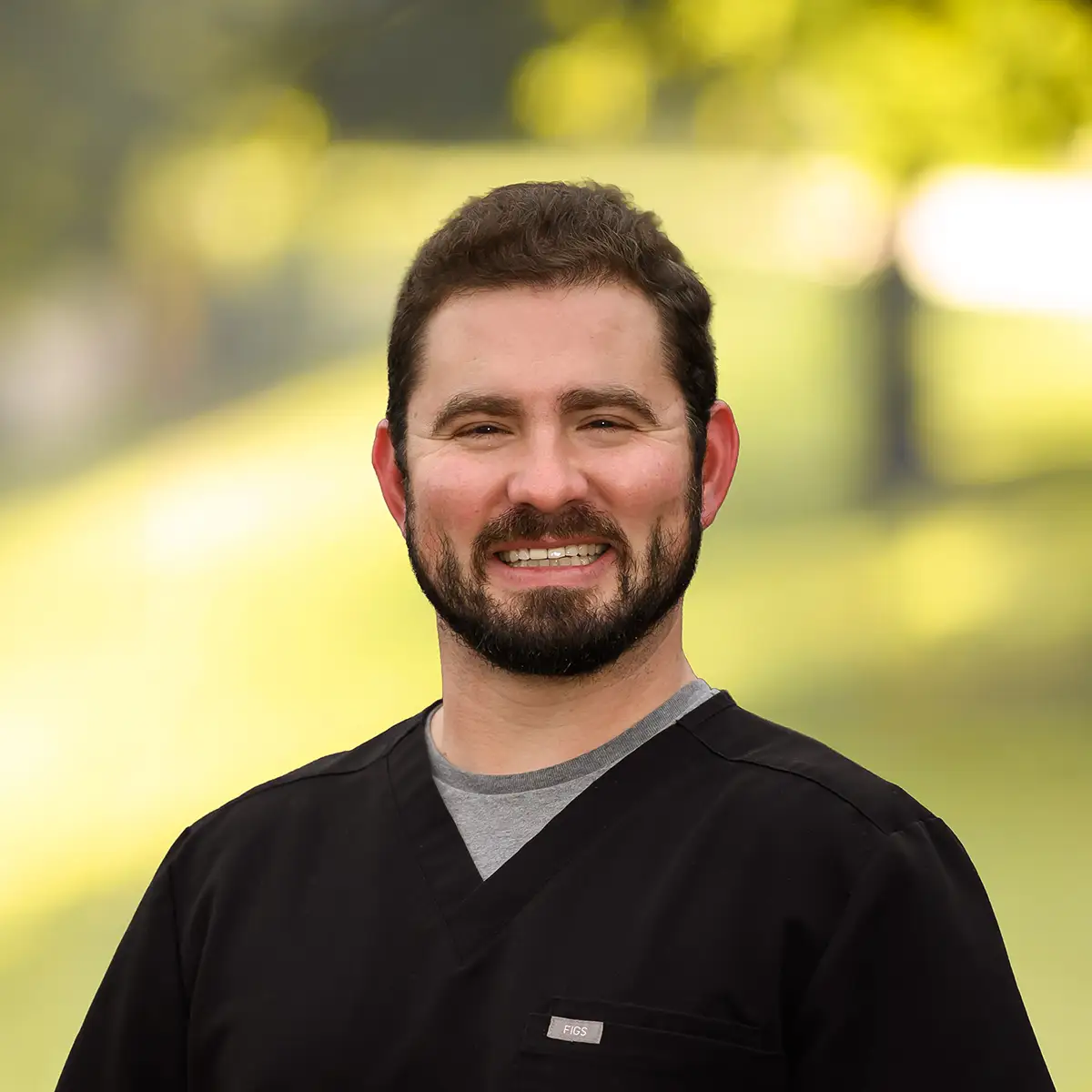
Brandon Menke, MD, is a board-certified ophthalmologist at ilumin Eye Care Center in Omaha, Nebraska. He earned his medical degree from the University of Iowa Carver College of Medicine and completed his ophthalmology residency at Palmetto Health–University of South Carolina. Dr. Menke completed a Doris Duke Clinical Research Fellowship in retinal regeneration and has published peer-reviewed research on retinal tissue restoration. He serves as Adjunct Assistant Professor of Oculoplastic Surgery at the University of Nebraska Medical Center.