
When families in Omaha consider cataract surgery, one question stands out: what does the clinical evidence actually show about having both eyes operated on the same day?
Is Same-Day Cataract Surgery on Both Eyes Safe in Omaha?
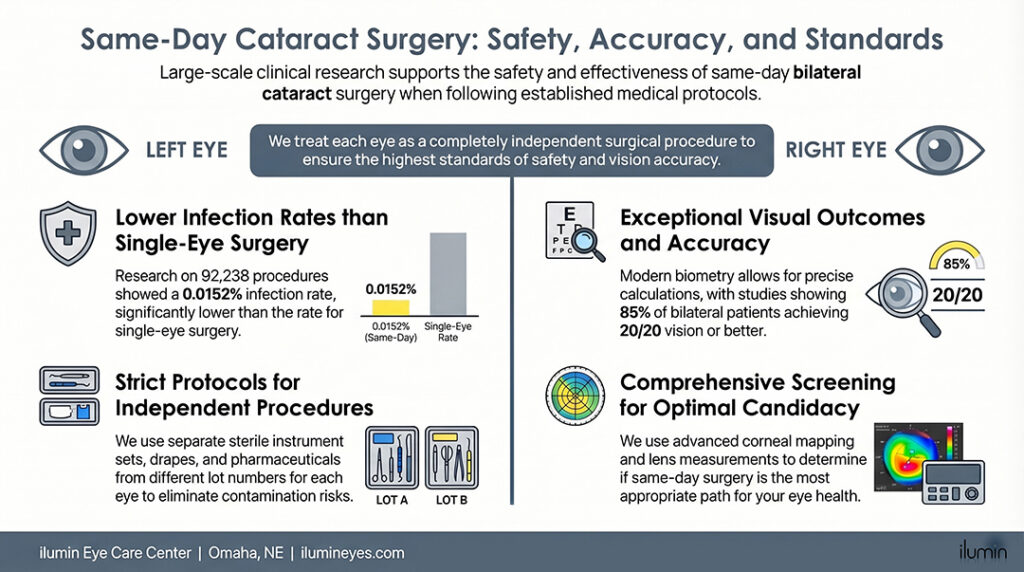
As of 2026, same-day bilateral cataract surgery — called immediately sequential bilateral cataract surgery, or ISBCS — carries a strong safety profile supported by large-scale clinical research when patients are appropriately screened and established protocols are followed. The Swedish National Cataract Register analyzed 92,238 ISBCS procedures from 2002–2017 and found an endophthalmitis infection rate of 0.0152%, significantly lower than the 0.0299% rate for single-eye surgery. Omaha ophthalmologists offering ISBCS treat each eye as an independent surgical procedure.
ilumin Eye Care Center in Omaha offers same-day bilateral cataract surgery, allowing patients to complete both eyes in one day. ilumin’s board-certified ophthalmologists follow International Society of Bilateral Cataract Surgeons (ISBCS) protocols for every bilateral procedure.
What Does Research Show About Infection Rates for Same-Day Bilateral Cataract Surgery in Omaha and Nationwide?
The Swedish National Cataract Register, analyzing 92,238 ISBCS procedures from 2002–2017, found an endophthalmitis rate of 0.0152% for same-day bilateral surgery, compared to 0.0299% for single-eye surgery. The UK Royal College of Ophthalmologists National Ophthalmology Database, covering more than 1.35 million operations, recorded zero endophthalmitis cases among 2,315 ISBCS patients. A separate study of 1,335 bilateral patients also reported zero infections.
ilumin’s board-certified ophthalmologists perform bilateral procedures following the same evidence-based protocols reflected in these large-scale registry studies, adhering to ISBCS safety standards for every case in Omaha.
How Do Omaha Cataract Surgeons Prevent Complications When Operating on Both Eyes the Same Day?
Omaha cataract surgeons performing same-day bilateral procedures prevent complications by treating each eye as a completely independent surgical procedure. Separate sterile instrument sets, drapes, gloves, and gowns are used for each eye, and pharmaceutical agents — including antibiotics, dilating drops, and anesthetics — must come from different manufacturer lot numbers to eliminate any risk of batch contamination.
Dr. Peter Simone and Dr. Brandon Menke, a board-certified ophthalmologists, perform bilateral cataract surgery at ilumin in Omaha in a QUADA Class A accredited surgery suite — treating each eye as a fully independent procedure for every case.
What Is Endophthalmitis and How Common Is It After Same-Day Cataract Surgery?
Endophthalmitis is a rare but serious infection inside the eye and the primary safety concern associated with any cataract surgery, whether performed on one eye or both the same day. The Swedish National Cataract Register found an endophthalmitis rate of 0.0152% for ISBCS procedures, while a UK study of 2,315 bilateral patients recorded zero cases. Modern surgical protocols have made this complication exceedingly rare when proper standards are followed.
When Might an Omaha Surgeon Recommend Waiting Between Cataract Surgeries Instead of Doing Both the Same Day?
Surgeons may recommend waiting between cataract surgeries when patients have a history of eye infections, complex ocular conditions, or significant prescription differences between the two eyes. Patients with conditions requiring customized IOL calculations that benefit from using the first eye’s surgical outcome to refine the second are also candidates for sequential scheduling. That determination is made during a comprehensive preoperative evaluation assessing individual risk factors.
ilumin Eye Care Center’s ophthalmologists perform comprehensive preoperative evaluations, including corneal mapping and lens measurements, to assess whether same-day bilateral surgery is appropriate for each patient. When individual risk factors indicate sequential scheduling is clinically appropriate, ilumin’s surgeons discuss this option with patients during the preoperative evaluation.
Is Same-Day Bilateral Cataract Surgery in Omaha as Accurate as Having Each Eye Done Separately?
As of 2026, research indicates same-day bilateral cataract surgery achieves comparable or superior refractive accuracy to sequential surgery. A September 2025 study from Moorfields Eye Hospital presented at ESCRS found 85% of bilateral multifocal patients achieved 20/20 or better vision, compared to 77% for patients who had their eyes done on separate days. Modern biometry allows precise IOL calculations for both eyes independently, regardless of surgical timing.
ilumin uses advanced biometry and corneal measurement technology to determine precise IOL power for each eye, supporting accurate outcomes whether surgery is performed on the same day or across separate visits.
What Questions Should I Ask My Omaha Surgeon Before Agreeing to Same-Day Cataract Surgery on Both Eyes?
Patients considering same-day bilateral cataract surgery in Omaha typically ask about their surgeon’s infection prevention protocols, experience performing bilateral procedures, and whether their individual eye health makes them a suitable candidate. Informed patients also ask what happens if a complication occurs in one eye, how IOL power is determined for each eye independently, and what the surgeon’s complication rate is for bilateral versus sequential procedures.
ilumin Eye Care Center’s board-certified ophthalmologists address these questions in detail during preoperative consultations, covering bilateral surgery experience, infection prevention protocols, and individual risk assessment. A consultation includes a candidacy determination based on each patient’s eye anatomy and medical history.
What Safety Protocols Do Omaha Cataract Surgeons Follow for Same-Day Bilateral Procedures?
As of 2026, Omaha cataract surgeons performing same-day bilateral procedures define each eye as a completely independent surgical procedure. Requirements include separate sterile packs, instruments, gloves, gowns, and drapes for each eye, with pharmaceutical agents sourced from different manufacturer lot numbers. The surgeon re-scrubs and re-gowns between eyes.
ilumin’s board-certified ophthalmologists complete each eye as a completely independent procedure, giving Omaha patients access to this evidence-supported approach to cataract care.
Key Takeaways: Is Same-Day Bilateral Cataract Surgery Safe in Omaha?
The Swedish National Cataract Register analyzed 92,238 same-day bilateral procedures from 2002–2017 and found an endophthalmitis rate of 0.0152%, lower than the 0.0299% rate for single-eye surgery.
Same-day bilateral cataract surgery protocols require each eye to be treated as a completely independent procedure, with separate sterile instruments, drapes, and pharmaceuticals from different lot numbers.
A September 2025 ESCRS/Moorfields study found 85% of bilateral multifocal patients achieved 20/20 or better vision, compared to 77% for patients who had their eyes done on separate days.
Surgeons may recommend sequential surgery for patients with a history of eye infections, complex ocular conditions, or significant prescription differences between the two eyes.
To discuss whether same-day bilateral cataract surgery is right for your individual eye health, schedule a consultation with ilumin Eye Care Center in Omaha at 402-933-6600.

Brandon Menke, MD, is a board-certified ophthalmologist at ilumin Eye Care Center in Omaha, Nebraska. He earned his medical degree from the University of Iowa Carver College of Medicine and completed his ophthalmology residency at Palmetto Health–University of South Carolina. Dr. Menke completed a Doris Duke Clinical Research Fellowship in retinal regeneration and has published peer-reviewed research on retinal tissue restoration. He serves as Adjunct Assistant Professor of Oculoplastic Surgery at the University of Nebraska Medical Center.